The journey towards greater efficiency began with the development of a single product, but it quickly became clear that this project had far-reaching implications for our entire manufacturing process. It was a pivotal moment that underscored the need for comprehensive improvements across all stages of production. In response, we shifted our focus to optimizing our manufacturing journey to meet current regulations and industry standards while laying the groundwork for future growth.
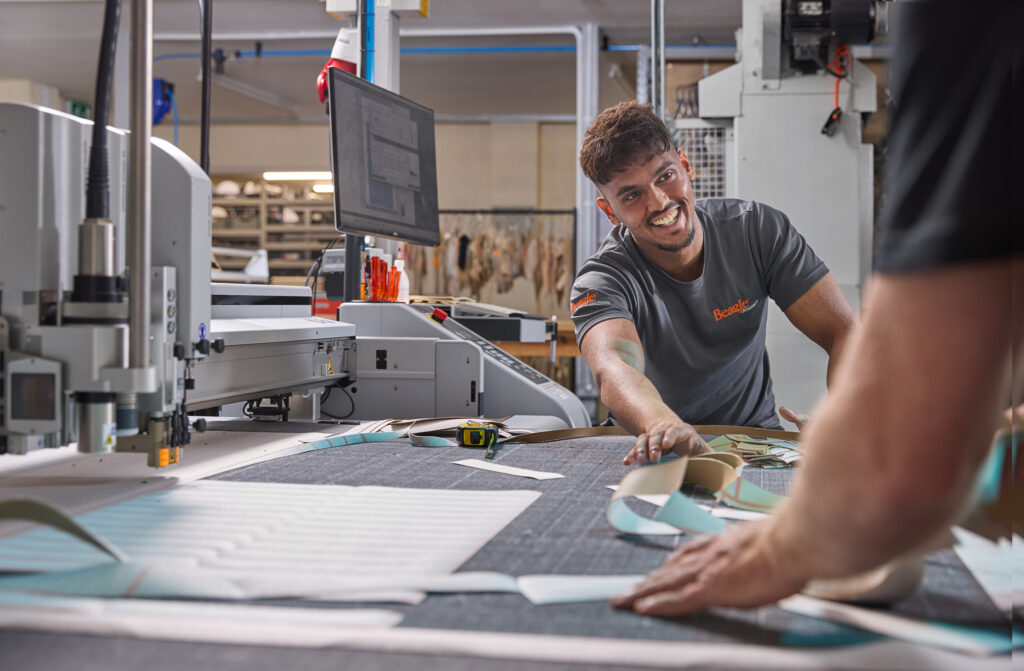
Sustainable growth, however, demands more than ambition—it requires the right resources, both in terms of technology and skilled labour. As part of the thriving manufacturing sector in the North West of England, Beagle is proud to contribute to the region’s legacy. In fact, 318,000 people are employed in manufacturing here, and Lancashire remains the UK’s leading region for textile employment. Our own manufacturing team boasts over 200 years of combined experience, making us a cornerstone of this vibrant industry.
Despite this rich history, we face a growing challenge: the diminishing availability of new talent with specialised sewing skills. As industry veterans retire, the pool of expertise is shrinking, making it increasingly difficult to find skilled workers to support our expansion goals. In order to grow, we not only need new technologies but also a workforce equipped with the necessary skills to use them. This challenge has underscored the importance of innovation in driving efficiency and ensuring long-term sustainability in our operations.

Recognising the need for a bold shift, we embarked on a mission to research cutting-edge technologies that could support our growth strategies. We explored various options, including subcontracting and outsourcing, to scale up operations. However, concerns about the reliability of our supply chain made these alternatives less attractive. The stability and quality we demand in our products simply couldn’t be guaranteed through external providers. We needed a solution that would allow us to maintain full control over production, quality, and timelines.
As we dove deeper into planning, it became increasingly clear that the solution we needed didn’t exist within our industry—at least, not yet. This realisation ignited a desire to control our future rather than wait for the market to catch up. We made the strategic decision to become pioneers in UK manufacturing by investing in innovative technologies that integrate seamlessly with our long-established processes. Thus, the Transformation Project was born.
The Transformation Project wasn’t just about installing new machines or upgrading software—it represented a holistic overhaul of how we approached manufacturing. From digitizing production lines to creating more automated workflows, we sought to revolutionise every aspect of our operations. This project is more than a response to immediate needs; it is a proactive measure to future-proof our business, ensuring that we can continue to deliver high-quality products while staying competitive in an evolving market.
A key pillar of the Transformation Project is our commitment to sustainability. We understand that true innovation must also respect our responsibility to the environment. This initiative goes beyond technological advancements—it encompasses significant structural changes to our facility, a thorough evaluation of our supply chain, and a forward-thinking automation initiative.
This transformation has provided us with a unique opportunity to enhance our sustainability efforts. Environmental stewardship has always been a core value for Beagle, and it aligns perfectly with the broader goals of key partners like the NHS, who are committed to achieving net-zero carbon emissions by 2045 as part of their Evergreen Sustainable Supplier Assessment. By adhering to these ambitious targets, we are not only reducing our operational costs but also reinforcing our role as responsible contributors to a sustainable future.
While we consistently evaluate our carbon footprint and environmental impact in our daily operations, the Transformation Project is set to make a significant difference in the long run. Through energy-efficient systems, waste-reduction strategies, and streamlined processes, we expect to drastically reduce emissions and consumption. This project positions us to lead the charge toward a greener manufacturing sector, aligning innovation with sustainability to secure a more prosperous future for both our company and the planet.